

Five months ago, the tech sector experienced a collective panic attack. When advanced, highly capable agentic tools like Claude Code and Claude Cowork hit the market, they did not just change how developers work, they fundamentally broke the underlying assumptions of the traditional business software model. Almost overnight, public software stocks experienced a massive sell-off, wiping out roughly a trillion dollars in market capitalization as investors realized that the old rules of selling software were dying. 🤯
Now that the initial market shock has cooled, founders are looking around at the hangover, asking a simple question: what happens next?
The initial panic was abstract, but the operational reality today is incredibly concrete. The old business playbooks are officially outdated. However, if you are running an early-stage startup, you actually hold a massive structural advantage over the multi-billion-dollar incumbents, provided you build on the right foundation.
Are Companies Really Losing Money?
There is a huge difference between a public stock valuation crashing and a company's day-to-day revenue dropping. Because enterprise software contracts are notoriously sticky, usually locked into multi-year agreements, the tech giants did not lose all their sales overnight. Instead, the market was pricing in future revenue destruction.
But out in the real world, mid-market startups and single-purpose point solutions are actively bleeding right now.
Its believed that CFOs are aggressively enforcing a SaaS seat freeze. When companies deploy an AI agent that can automate the work of multiple people, they stop buying new software user licenses. This headcount compression is stalling out the growth of legacy platforms. At the same time, companies are actively canceling niche tools. Why pay thousands of dollars a year for separate copywriting, translation, or basic data-sorting apps when a centralized AI engine can do it all? Every single dollar being redirected into automated workflows is a dollar pulled away from traditional user seats.
1. You need Consumption-Based Pricing, Yesterday
If you launch an early-stage startup today with a pricing page based entirely on user seats, you are capping your own growth. As customers optimize their teams using automation, seat counts will continue to shrink. Startups must transition to consumption or outcome-based pricing, charging for the actual utility, credits, or results their software delivers.
But here is the catch: to bill your customers accurately based on outcomes, you have to know your own underlying operational costs down to the exact execution loop. AI isn't free, and background computational work can quickly erode your margins if left unchecked.
This is exactly where Tower comes in. Tower provides an elastic, serverless Python runtime built for modern infrastructure. When your customer's automated agent or background data pipeline is running, Tower scales up to handle the load. When the job is done, it scales completely down to zero.
Because you aren't paying for idle, always-on servers, your underlying infrastructure costs perfectly mirror your revenue model. Tower gives you the precise control over compute costs needed to protect your margins while offering competitive, consumption-based pricing to a market that refuses to buy traditional software seats.
2. Transform your Passive System into an Active One
For the past twenty years, software has focused on being a passive system of record. These are platforms that act as glorified digital filing cabinets, holding your data, displaying a clean dashboard, and waiting for a human to log in and do the work. The next generation of software must be a system of action, utilizing autonomous agents that monitor data, make decisions, and execute tasks in the background.
Building actionable software means letting your code interact directly with complex data stacks, a process that (correctly) terrifies engineering teams worried about data corruption or system downtime.
[Legacy Software] ──> Passive UI ──> Human logs in to click & type
[Actionable Software + Tower] ──> Isolated Ephemeral Env ──> Automated Agent Execution
Tower makes deploying automated data agents and background orchestration pipelines incredibly safe. It provides isolated, ephemeral environments that allow your background workflows to run seamlessly. You can schedule routine automation, manage data pipelines, and let agents process information using a copy of your data rather than experimenting on live, production databases. Tower transforms the data layer from a static archive into a safe, active playground for autonomous features.
3. Embrace Vibe Coding (with Production Guardrails 😉)
There is a lot of anxiety around the rise of vibe coding, the idea that non-technical people can now use AI to prompt entire internal tools and scripts into existence over a weekend. Traditionalists view this as a threat to code quality and software stability.
For an early-stage startup, vibe coding is a superpower. You should let your lean team use AI tools to generate as much functional Python code, data transformations, and custom scripts as they can muster. The trick is making sure those scripts do not turn into an unmanageable, fragmented mess.
Tower serves as the centralized control tower for this environment, delivering Docker-meets-Dagster simplicity without the massive infrastructure overhead. It provides a single source of truth where everyone on your team, regardless of engineering depth, can see exactly what is running, securely manage API keys and secrets, and operationalize scripts safely.
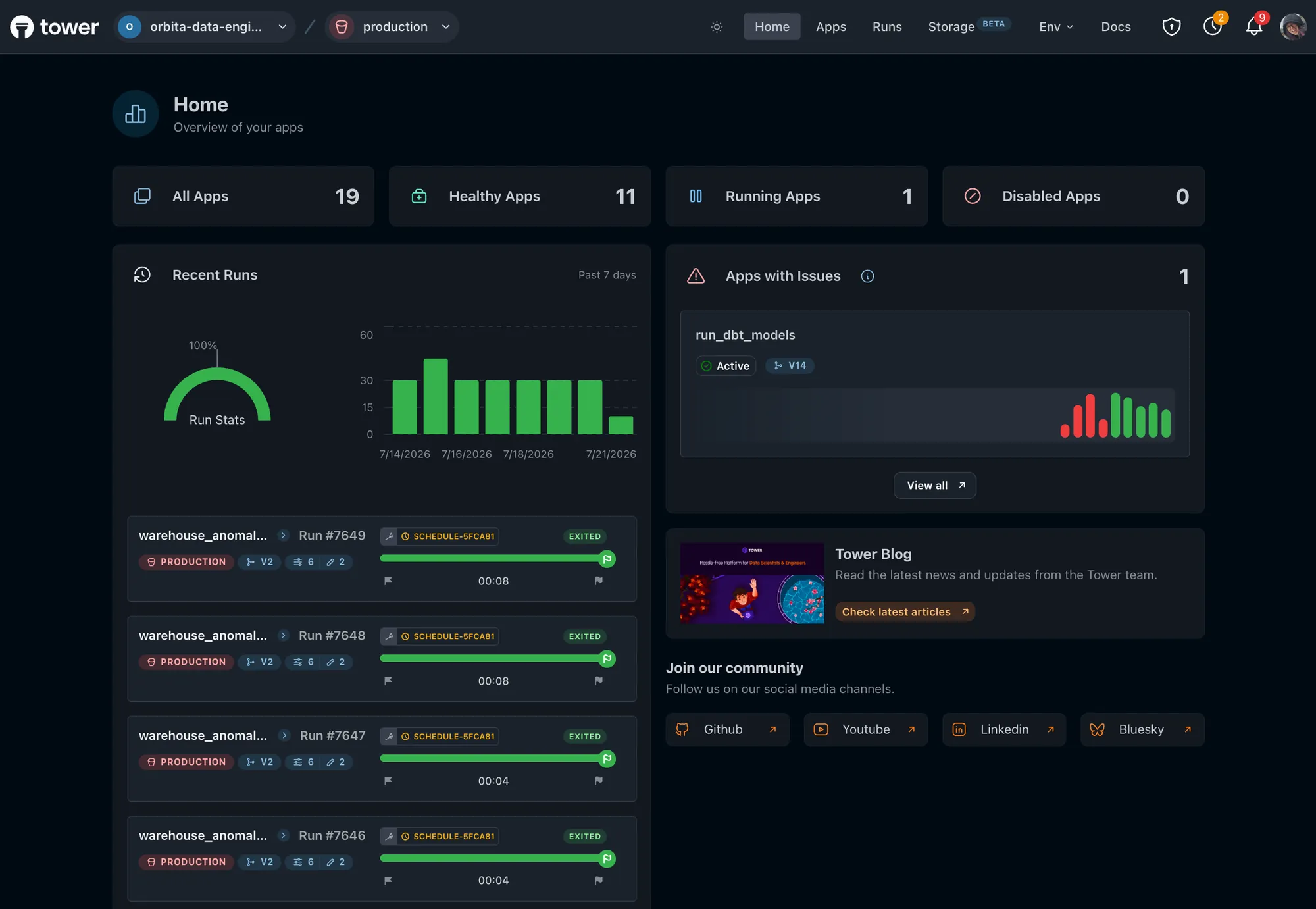
You can use it to build features directly into your core product, manage data pipelines, or gain instant operational insights. It gives a small, early-stage team the operational guardrails to build, test, and ship at the speed of AI while ensuring everything remains stable and secure.
4. The Startup Advantage
The SaaS-pocalypse is not an extinction event for software, it is a forced migration. Legacy software giants are completely trapped, handcuffed to old, rigid database architectures and multi-million-dollar user-seat revenue models that they are absolutely terrified to cannibalize.
As an early-stage founder, you have no legacy revenue to protect and little tech debt to hold you back. By leveraging Tower to handle the complexities of serverless execution, isolated data environments, and orchestration, you can build an incredibly lean, action-oriented product from day one. You can map your infrastructure costs perfectly to customer value, ship features faster than your competitors, and run circles around incumbents who are still trying to figure out how to sell user licenses in an agentic world.
The rules have changed, but the advantage is entirely yours.
The New Beginning?
AI is forcing SaaS companies to rethink how they price, build, and deliver value. Seat-based software and passive systems of record are giving way to consumption-based products, autonomous workflows, and leaner teams that can ship faster with AI. For early-stage startups, this shift is an opportunity: with Tower's serverless Python runtime, isolated execution environments, and orchestration layer, teams can control infrastructure costs, safely run agentic workflows, and build action-oriented products without carrying legacy baggage.
Get Ready to Build for the Agentic Era
- Join the Tower community to connect with other builders, share what you're working on, and learn how teams are adapting to the new SaaS landscape.
- Try Tower's free tier to start running Python workflows, agents, and data pipelines without any upfront infrastructure cost.